
Fordthought
  • Blog
  • Word of the Week
  • Dig Deeper

Word of the Week: w/c 4/1/16 - Epiphany

5/1/2016


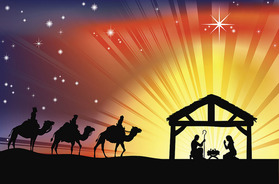
Epiphany, held on the 6th January, is a Christian festival which celebrates the revealing of Jesus as the Son of God and the visit of the Magi to the infant Jesus

Picture
Picture
This week is the festival of Epiphany; celebrated in the West on January 6th. It commemorates the arrival of the Magi who came to worship the infant Jesus. I don’t really want to get into a discussion about the likelihood of this event or who the Magi were but I do think It is interesting to think a little more deeply about the gifts that Magi offered and what this tells us about the person of Jesus. At the very least this can tell us what the only gospel writer who records their visit, Matthew (chapter 2), wanted to convey about the Messiah.


Gold is an expression of kingship on Earth, Gold was a highly valued metal and worn by rulers in crowns or other jewellery. Christians believe that Christ is the true king who now reigns in heaven. Jesus was also descended from the line of David, the greatest King of Israel who the Jews of Jesus' day yearned to see return and free them from oppression at the hands of the Romans (although Jesus is ultimately not this kind of Messiah)
Picture
Frankincense is an aromatic resin that is burned to give a sweet smell at times of prayer and worship. It was burned in the Temple to cover the smell of blood from sacrifices there is also a sense that the smoke rising carries prayer to God. This therefore is symbolic of Jesus’ role as deity - God made incarnate. 


Finally the myrrh is an embalming ointment that was used for anointing the dead. This therefore is representative of Jesus’ future suffering and death. Jesus' resurrection was indeed discovered by women coming to anoint his body - however there is no mention that this myrrh is what they intended to use.

One of my favourite Christmas carols that considers the symbolism of these three gifts is Bethlehem Downcomposed by Peter Warlock and written by Bruce Blunt. It picks up wonderfully on the duality of Jesus’ life - “gold for a crown” becomes “wood for a crown” and myrrh is given both for its “sweetness” and “embalming”. The juxtaposition of the first two major verses against the minor tonality of the last two works wonderfully. The last verse never fails to bring a lump to my throat. I hope you enjoy it as much as I do:
​

​When He is King we will give Him a King's gifts,

Myrrh for its sweetness, and gold for a crown,
Beautiful robes", said the young girl to Joseph,
Fair with her first-born on Bethlehem Down.

Bethlehem Down is full of the starlight,
Winds for the spices, and stars for the gold,
Mary for sleep, and for lullaby music,
Songs of a shepherd by Bethlehem fold.

When He is King they will clothe Him in grave-sheets,
Myrrh for embalming, and wood for a crown,
He that lies now in the white arms of Mary,
Sleeping so lightly on Bethlehem Down

Here He has peace and a short while for dreaming,
Close-huddled oxen to keep him from cold,
Mary for love, and for lullaby music,
Songs of a shepherd by Bethlehem Down.

Word of the Week: w/c 07/12/15 - Temple

4/12/2015


A building dedicated to the worship of gods or God.

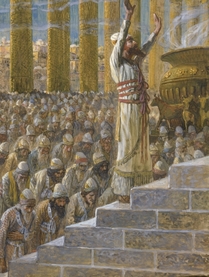
The Temple (definite article) refers to the Jerusalem temple

Picture
Picture
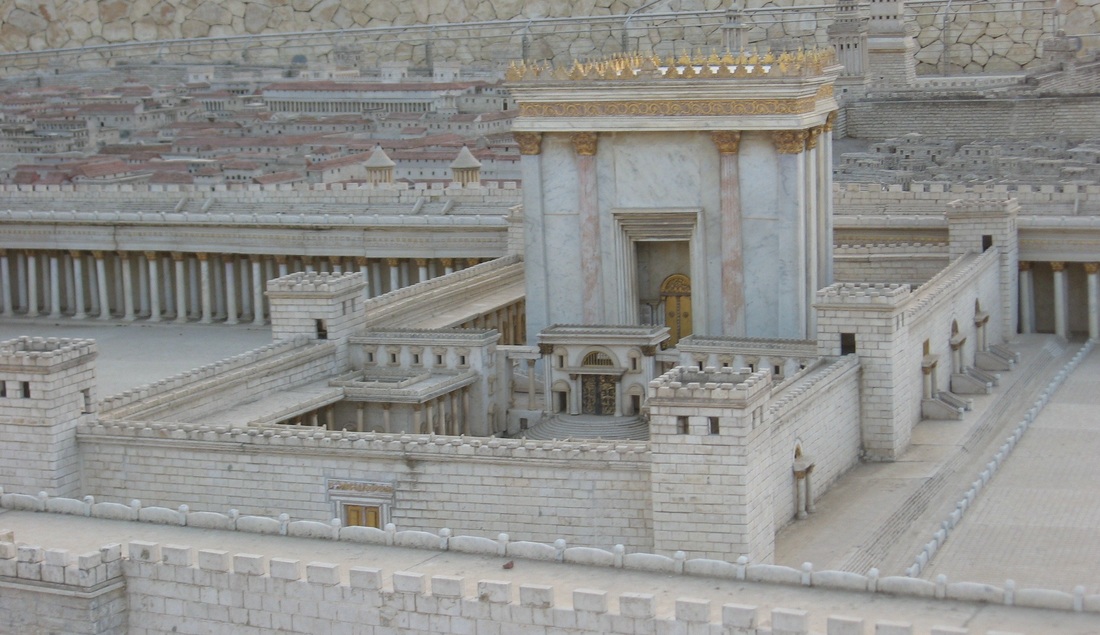
A re-creation of the Second Temple in Jerusalem. Image: Wikipedia.commons
You might argue that this Word of the Week should be Temples as over the centuries there have in fact been two Temples in Jerusalem. The first was built by King Solomon in 957BCE. It was built to the design of King David but was destroyed by the Babylonians in 587 B.C. It was later rebuilt and this is known as the “Second Temple”. It had a chequered history being plundered and damaged at various times by invading armies including that of the great Roman general Pompey. The Temple that Jesus would have known was renovated and expanded by King Herod the great when it became known as “Herod’s Temple”


The Temple in Jerusalem was the centre of Jewish religious life. It was used as a place of worship for major religious festivals and as a place of prayer.  There would be daily services there.  It was also a place of sacrifice where sins could be confessed and guilt transferred symbolically to an animal which was then slaughtered and burnt as an offering to God.  The animal had to be unblemished; the best of the flock or herd.  Poor people could sacrifice birds if that was all that they could afford.
PictureImage: wikipedia.commons
The Temple site was large and contained a series of courtyards.  The outer court was the Court of the Gentiles.  This was the only place where Gentiles were allowed to come and pray.  If they tried to enter the other courts, notices in Greek, Latin and Hebrew warned them that to do so risked death!    Inside that was the Court of the Women. Then you came to the Court of the Men where only Jewish men could pray.  The innermost courtyard was reserved for the priests.  It contained the altar on which sacrifices were burnt as well as the sanctuary which was the holiest part of the site.  The sanctuary was a smaller building which was subdivided into two by a huge curtain.  Behind it was the Holy of Holies where God’s presence dwelt. Only the High Priest went into the presence of God and only once a year after making sacrifices for his sins on the day of Yom Kippur.  He interceded for the people of Israel.

PictureImage: wikipedia.en
So it was that the temple was a place where a Jew could access God in some ways but it shut many out from the immediate presence of God; Gentiles, women, sinners, sick people (sinners and the sick or deformed were regarded as too spiritually unclean to be allowed in). This may have been what angered Jesus the most – throughout his ministry he had an interest in the outcasts of society.


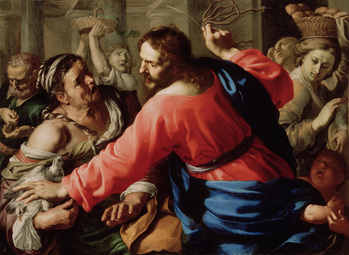
Sometime during what Christians now call “Holy Week” – the final week before Jesus’ crucifixion - Jesus created a major disturbance in the Court of the Gentiles.  The Gospels report that he violently overturned the money-changers’ tables and the booths of the sellers of animals.  In a way, each had a legitimate place in the temple.  The animals were needed by those who could not supply their own.  The temple money alone could be used to pay the temple tax (Roman money was considered pagan and unclean).  Mark’s Gospel records that Jesus regarded the temple as ‘a den of robbers’.  Perhaps they were guilty of ripping off the people who came.  At any rate, quoting the O.T. Jesus said that God wanted it to be a place of ‘prayer for all nations’.  Clearly the Court of the Gentiles had gradually become full of traders and money changers and prayer was not possible.  So the Temple was not fulfilling its most important function – to unite Man and God.

By creating this disturbance, Jesus was challenging the whole temple system.  He knew exactly what he was doing.  His ‘riot’ was deeply symbolic.  He regarded the system as rotten at its core and perhaps in need of total reform which was really unlikely to happen.  He later predicted (to his disciples) the complete destruction of the Temple, something that did in fact happen in AD 70 at the hands of the Romans.  Many people at the time regarded the priests as corrupt in any case (many were very wealthy) and Jesus may well have shared that view. Sick and deformed people were not allowed in. He would have been seen as a threat to the moral and spiritual authority of the priests.



Jesus spent a lot of time in The Temple once he came to Jerusalem.  Its courts were a place where people gathered to discuss and argue about matters of faith and belief.  Mark records a number of disputes that Jesus had with religious leaders.  More controversy!


Word of the Week: w/C 30/11/2015 - Hospice

29/11/2015


A home providing care and support to the sick or dying and their families. Originated as a lodging for travellers run by religious Organisations.

Picture
PictureImage: cicelysaundersarchive.wordpress.com
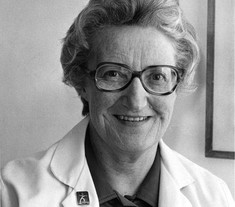
The School's Philosophy Society, Ontos, was fortunate enough to receive a talk earlier this month from Joanne Fernandes, a hospice nurse at  The Hospice of St Franics, Berkhamsted. 

Ms Fernandes initially set out the purpose and origins of the Hospice movement including the story of Dame Cicely Saunders and the role of St. Francis' hospice within Berkhamsted. Her respect for Dame Saunders was evident as she stressed the range of intellectual disciplines that she embraced and experienced on the way to founding the hospice movement; a fantastic message for any young person setting out on their academic career to garner as many experiences as possible. She also stressed her emphasis on an holistic approach to death and the need to give everybody intrinsic value.
 
She moved on to set out the work of St Francis' dispelling the myth that hospices are merely places that people go to die. Indeed, 40% of patients go home from the hospice. She also stressed the holistic treatment of St Francis; not just about the patient but also their families especially in providing bereavement services and preparing families for the death of their relatives. The hospice also provides a teaching role supporting doctors and nurses and visiting schools. It aims to provide "The best of the biomedical with the care of the spirit".
 
She then moved on to address the debate around assisted dying and the Bill in the House of Lords last summer. She set out the various arguments for and against assisted dying that were put forwards in the House of Lords. The main question being should the autonomy of the individual trump all others? Or does society, and especially doctors and nurses, have the right to decline such requests? She set out extremely well the problem of rights and duties and the clash between autonomy and the implication this would have on healthcare professionals.
 
Ms Fernandes was a fantastic communicator, full of energy and conviction about the hospice movement balanced with a good understanding of the intellectual arguments surrounding this debate. She may have had a personal opinion about these issues but she did not give it away or try to sway pupils one way or another. Her talk reminded me of how lucky we are to have such passionate and educated nurses working in palliative care.


Word of the Week: w/c 23/11/16 - Teleological

22/11/2015


From the Greek word ‘telos’ meaning ‘end’ or ‘purpose’. Teleological arguments try to establish the existence of God by suggesting that the universe contains evidence of purpose which only God could be responsible for.
​

Picture
PictureWilliam Paley Image: Wikipedia Commons
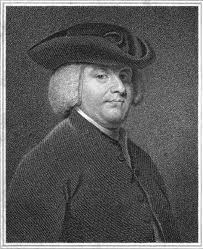
Over the centuries that Philosophy has been going on a great number of people have wondered at the apparent design on the world and suggested that this must lead the to conclusion that there is a divine being responsible for it. Aquinas, Derham, Swinburne, Tennent and Behe have all had their part to play, but probably the most famous version (and I don’t really know why!) was by William Paley - a nineteenth century Natural Theologian.

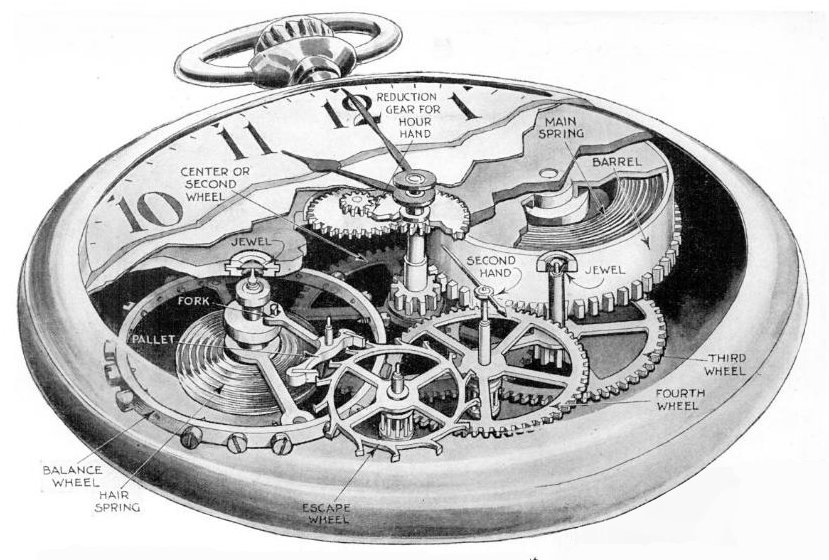
Paley’s famous argument for the existence of God proceeds analogically, taking the idea of a watch, and making an analogy with the universe. Paley concludes that since the watch requires a watchmaker in order to exist, the universe must exist by virtue of some being capable of creating such a magnificent and intricately designed thing; God is the only suitable candidate for this.


Paley’s argument is a species of teleological argument. The word teleological is derived from the Greek word ‘telos’ meaning ‘end’ or ‘purpose’. Teleological arguments try to establish the existence of God by suggesting that the universe contains evidence of purpose which could only have been put there by God.


​When we see certain effects in nature, it is reasonable to suppose that these effects have been produced by a particular type of cause. When we observe a snooker ball rolling along a table, for instance, it is usually reasonable to suppose that it has been caused to move by another ball or a snooker cue colliding with it, even if the cause itself was never seen (David Hume challenged this kind of thinking before Paley had even put pen to paper, but Paley seems unaware of his predecessor’s writing).


This type of argument is inductive: it proceeds from general premises to a specific conclusion. We know that complex objects having specific purposes are the product of intelligence, and teleological arguments apply this generalised fact to observable instances of complexity in the universe in order to establish that the universe was created by an intelligent being, i.e. God.

PictureImage: Wikipedia.Commons
In Paley’s time, humans were discovering more and more about the natural world. As technology advanced that allowed us to observe objects at ever-smaller scales, and allowed us to cross oceans and continents to make new discoveries, we began to uncover the complex ways in which things in the natural world seem to fit various purposes. In particular, the minute details of living organisms (now visible through microscopes) could be seen to be working together in ways that allowed the creature’s body to perform all sorts of functions. Not only that, but they performed these functions in a mechanistic fashion: predictable movements were made, with predictable results.

This tendency toward predictability bore an uncanny resemblance to the operation of human machines. Paley’s was an age in which engineering was advancing apace: from the large scale steam-ships and suspension bridges to large scale industrial mass-production to the minute world of mechanised automata, machinery and mechanisation seemed the very key to human advancement. These machines were designed by human beings who had specific purposes in mind, and designed the machines in such a way as to satisfy those purposes, making use of mechanisms that would produce predictable results and thus reliable machines. It would therefore seem compelling to suggest that evidence of predictability in nature suggested the existence of a designer who had a purpose in mind when it created the universe.

This was therefore the context of the argument in which Paley declared that if, in crossing a heath, he had struck his foot against a stone, he would not have wondered how it came to be there. After all, stones are not complex. They do not (superficially, at least) bear any marks of having been designed. But had he come upon a watch instead, Paley would have felt sure that the object had been designed by an intelligent being, due to its complex, intricate and purposeful nature.

Paley then went on to argue that if all the hallmarks of design present in the watch, they must also be present in the natural world. Paley gave the example that “the hinges in the wings of an earwig, and the joints of its antennae, are as highly wrought, as if the creator had nothing else to finish.” The characteristics that denote carefulness of design in man-made objects are present in the universe.

Not only are the hallmark complexities of design present in nature, but in Paley’s words are more evident in nature than in the watch “to a degree which exceeds all computation”. Paley thus concludes that God possesses not only the characteristics of a human designer, but an infinite degree of care and attention to detail. Not only does Paley’s argument thus claim to establish the existence of any deity, but an omnipotent and omnibenevolent God.

Paley’s argument builds on Aquinas’ argument before his. For Aquinas, the universe shows evidence of God’s design because of regularity: in Aquinas’ terms, “bodies that lack knowledge … act for an end, and this is evident in their acting always, or nearly always in the same way, so as to obtain a result.” Paley’s argument depends on a similar thesis of regularity, but (in keeping with the time of his writings), he expands this to encompass ideas of complexity as well. An examination of the watch’s workings reveals complexity that explains why it works with regularity when it is in motion.

This means that Paley can anticipate his critics by pointing out that if the watch failed to keep time exactly, that would not nullify the evidence of design found in it. The high degree of complexity and the fact that this aims at a function, even if that function is not fully achieved, still counts as strong evidence of design. Therefore even if things in the world do not always function perfectly, such as potatoes being wiped out by blight, and animals going extinct this does not nullify the evidence of design to be found in the complexities of the potato plant’s biological workings. The greatness of designed complexity to be seen in nature points to God’s existence even if its intended function is not always achieved.

There are of course many who dismiss the Teleological argument as fanciful, overly positive about the purpose of the world and simply wrong. As Darwin proposed and Dawkins & Dennett would later argue, the world is not designed with a purpose in mind, rather it is that we perceive order and purpose when there is none. But if you want to learn about these criticisms you will have to wait for another word of the week...

Word of the Week: w/c 16/11/15 - Covenant

15/11/2015


Literally, a contract. In the Bible, an agreement between God and his people, in which God makes promises to his people and, usually, requires certain conduct from them. In the Old Testament, God made agreements with Noah, Abraham, and Moses.

Picture
PictureImage: Pixabay

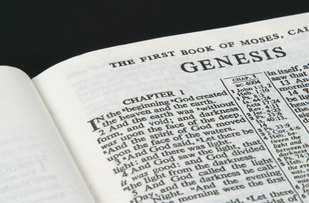
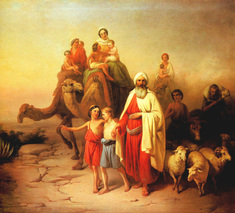
​The story of Abraham and his descendants is found in the book of Genesis. We first meet him in Genesis chapter 11, although at this stage his name is Abram. There is very little detail about him apart from the fact that he was a shepherd and came from Ur in Mesopotamia - modern day Iraq - after which he and his family moved, with his father Terah, to Haran.

Abram and his family journeyed from Ur in modern-day Iraq to Israel via Syria 
This was a polytheistic age, an age when people believed in and worshipped many gods. Yet within this atmosphere, Abram answers the call of God and it is because of this that he accepts and realises the reality of there being only one true God.

Abraham was the first person to recognise and worship the one God. And so, monotheism was born.
​

At the beginning of Genesis chapter 12, God asked Abram to leave his home and country and he makes Abram three promises: the promise of a relationship with God, numerous descendants and land (Genesis 12: 1-3).
"I will make you a great nation
And I will bless you;
I will make your name great,
And you will be a blessing
I will bless those who bless you,
And whoever curses you I will curse;
And all the peoples of the earth
Will be blessed through you"
PictureAbraham and his family Image: Wikipedia
The only problem is that both Abram and his wife, Sarai (later called Sarah) are old people and childless. They will have to leave their homeland and they don't even know who this God is! They seem to be an almost impossible set of promises for God to keep. But the amazing fact about Abram is that he does what he is asked. Abram has to place his trust in this nameless God. Consequently, Abram has gone down in history as a man of tremendous faith. As a result of his obedience, God changes his name to Abraham, meaning father of the people, and they solemnly promise each other that God will give them a land, many descendents and special care. Abraham for his part promises that he will be obedient to God, worship him and circumcise his offspring as a sign of the covenant (a practice carried out by Jews to this day)

The important thing to learn here is the uniqueness of the Covenant relationship between God and Abraham. For the first time, we see the beginning of a 2-way relationship: God is doing something for Abraham, and Abraham is doing something for God. The blessings of God are passed on from one generation to another.

Word of the Week: w/c 09/11/15 - Viability

8/11/2015


The point at which a foetus could survive outside the womb independent from its mother.

Picture
When students are studying the Sanctity of Life and the issue of Abortion a question that is often asked by teachers and students is “when does life begin?”. This is a very thorny issue and the answer depends upon what one might define by the term "life". There is no doubt that an egg that has just been fertilised is alive, but many disagree that it is yet “a life” as it could not exist independently of its mother. This moment is called viability, and in the UK is a fundamental part of our law on Abortion. Yet many would argue that a foetus is a life before this point and so has rights either from conception or very early in its existence. Some would argue that this point in the development makes no difference to the foetus’ rights and they do not begin until birth. This post looks to examine a few of the points at which it could be argued that a foetus is “a life” and reasons for and against that point being accepted.
PictureImage: Pixabay
 Conception - day 1

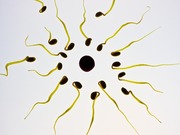
Many religious ethicists, for example Roman Catholics, argue that the clearest and most logical point to say that life has begun is at the moment of conception when egg and sperm fuse together. This is when the complete genetic make-up of an individual is in place and thus a unique human has been made. The problem with choosing this moment is that the embryo is likely to never be born (1 in 5 embryos never even implant in the lining of the uterus) and arguably this is only a potential life at this stage. It is just a bundle or rapidly dividing cells with no sentience (ability to feel pleasure or pain) or autonomy.

PictureImage: Wikipedia.en
Blastocyst - day 9

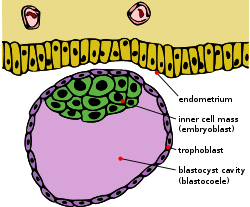
After five days the fertilised egg becomes a blastocyst becomes a cell with differentiated cells - cells that perform different functions - they have a cell wall and an inner cell mass that will become the embryo. By day 9 this blastocyst has become so specialised that it can no longer divide in two and become identical twins. Some therefore at this point argue that the life has begun as before this there could have been monozygotic twins. This is an interesting point in the pregnancy and is the reason why the Church of England argues that it is OK to carry out experiments on embryos before this day - but ultimately it could be argued it is still a potential life and not able to survive independently.

PictureImage: Pixabay
Viability - approximately Week 22

Before week 22 the foetus has all of the organs and structures of the body formed - it is just a case of growing these further. However if the foetus was to be born or removed from the womb at this point it would not survive. The odds start to change at about week 22 there is a 10% chance of survival. This is clearly not much of a chance and would have to brought about with extreme neo-natal care - never-the-less this is the first chance that a foetus has to survive. The chances of survival increase day by day so that by week 25 50% of babies survive and it is 95% by week 35.

Whilst this is the reason why the law governing abortion was set at 24 weeks (unless there is a serious medical reason) it can be argued that at this stage the baby will require such intensive care that it should not be considered as a practical justification

PictureImage: Pixabay
Birth - Weeks 38-42

Most pregnancies result in a natural birth at some point between 38 and 42 weeks. The baby simply becomes too big for the womb and has to be born. Babies that go this far into term have a very good chance of survival independently of their mother (>98%) and certainly most people have no problem with suggesting that they are alive at this point (interestingly Peter Singer has made the case that even when born a baby does not have the right to life as it has so much development still to complete and is still utterly dependent on a carer for its survival).


So?

When is a foetus a life? There are many more potential points that could be considered than I have discussed here - for example when the foundations of the nervous system have developed on day 20; on day 40 when brain waves can be detected; or in week 8 when all of the organs have been formed. The debate will of course continue to rage on.

A final thought is that students I teach are often surprised how developed the foetus is early on in the pregnancy - by week 24 and the point of viability the foetus has been essentially “complete” for 16 weeks. Many are not as happy with 24 weeks being the social abortion limit having learnt this information. I do not know when we should class a foetus as living and independent - but I do think that 24 weeks is too late. What do you think?

Word of the Week: W/C 19/10/15 - Trinity

17/10/2015


Three persons of the Christian Godhead; Father, Son and Holy Spirit

Picture
The Christian concept of the Trinity is crucial to the Christian faith and yet is extremely difficult to comprehend and a mystery even to those who profess to be Christian. Put simply it is the belief that God is Three persons yet one God (Tri-Unity). Each of the persons of the Trinity expresses the different characteristics of God; The Father is the creator, The Son is the redeemer and The Holy spirit is the sustainer. They are these three persons and yet they are all one substance (Homoousios) and so Christianity is a Monotheistic faith.

But perhaps rather than trying to explain how the doctrine of the Trinity works it might be better to explain how it does not work! There are a number of analogies that do the rounds to try and explain the Trinity; whilst these analogies do help to unlock aspects of the doctrine they are always destined to fail in some way (and this is in the nature of analogies). So I am going to go through a few of them to point out what goes wrong with them.
PictureImage: northpennwater.org
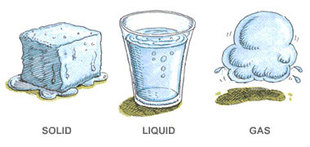
H2O; Ice, Water and Steam

The idea is that H2O has three states; solid, liquid and gas. In the same way God has three persons. The issue is that H2O is never in these three states at once whereas God is Father, Son and Holy Spirit at the same time. If you were to believe this of the Trinity you would be guilty of the heresy (theological error) of Modalism; believing that God was the Father in the Old Testament, changes to to Jesus in the New Testament and then is the Spirit from the day of Pentecost onwards. However events in the New Testament such as Jesus’ baptism show this to not be the case; the three are all present at the same time.

PictureImage: ClkerFreeVectorImages
The Egg

Sometimes people say the trinity is like an egg - having three parts (shell, white and yoke) and yet being one egg. This analogy is poor because the three parts are totally different substances and so it is guilty of the heresy of Tritheism - believing that there are three gods and not one.

Characteristics

Sometimes people suggest that the persons of the Trinity is similar to how an individual person has a number of characteristics; I am a father, husband, teacher etc. The problem here is that It denies the distinctions between the persons of the Trinity. Ultimately I am still me in all there three situations. This therefore is the heresy of Modalism again.
PictureImage: inspiredimages
Three Leaf Clover

St Patrick, the patron saint of Ireland, is said to have used the Shamrock, the three-leaved clover, to explain the concept of the Trinity. It is one flower and yet has three parts. The big problem with this analogy is that the three leaves. whilst they are the same substance they are not three parts of God, they are three persons. It splits them too much and again could be seen as Tritheism.

The Sun, its light, its heat

Finally, could we think of the Trinity as the Sun (Father) which generates light (Son) and heat (Spirit). This analogy has the serious problem that the light and heat are not separate persons, rather they are the by-products of the Sun. Therefore this analogy commits the heresy of Arianism; the belief that Jesus and the Spirit are entirely distinct from Father and subordinate to him.

So What?

Well if none of these analogies work then what can we say? Perhaps there are two potential responses. We could suggest that the Trinity as a doctrine is not really as important and relevant and theologians have claimed it to be. As Karen Armstrong has said:
“Jesus did not spend a great deal of time discoursing about the trinity or original sin or the incarnation, which have preoccupied later Christians. He went around doing good and being compassionate” - “Atoms and Eden” ed. by Steve Paulson.
Or we could adopt the view that the Trinity is a mystery that is not going to be fully understood by us but we can just try to express it as clearly as possible. As the Athanasian Creed puts it:
“We worship one God in trinity and the trinity in unity, neither blending their persons nor dividing their essence”

Word of the Week: W/C 12/10/15 - Utility

11/10/2015


Judgement about an action as to whether it produces benefit, advantage, pleasure, good or happiness. Associated with Utilitarianism as set forth by Jeremy Bentham.
​

Picture
PictureImage: en.wikipedia.org
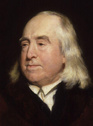
For much of the history of Moral Philosophy those who have proposed ideas about right and wrong have done so on the basis of rules and tradition. Thomas Aquinas, Immanuel Kant, Plato, Rene Descartes, William of Ockham, Nagel and Scanlon have all proposed various versions of rule based ethics. But in 1789 Jeremy Bentham, building on the work of other philosophers such as Joseph Priestley, changed the world of ethics when he introduced the concept of Utility in his work The Principles of Morals and Legislation.

Sometimes known as the greatest happiness principle, the principle of utility is the aim that actions should produce more pleasure that pain. As he wrote in The Principles of Morals and Legislation:
Nature has placed mankind under the governance of two sovereign masters, pain and pleasure. It is for them alone to point out what we ought to do, as well as to determine what we shall do. On the one hand the standard of right and wrong, on the other the chain of causes and effects, are fastened to their throne. They govern us in all we do, in all we say, in all we think…
PictureImage: jpornelasadv
So it was that Bentham suggested that when we decide how to act we should think about how much pleasure our action will bring about and balance that against the amount of pain we will cause. So if torturing one person will prevent the deaths of ten innocent citizens then this is a moral action. He suggested that we can make this decision using a calculus (known variously as the hedonic or felicific calculus) to weigh up the extent, duration, propinquity etc of the action.

Bentham was also a very modern thinker for the eighteenth century - he argued that every individual counts equally regardless of status and that there should be no distinction between the type of pleasure being assessed - "pushpin is as good as poetry".

Many students that I teach rather like Bentham when they hear about him for the first time - his disregard for tradition, religion and the authorities of his age make him appealing. However it does not take long to show that it is not really a very sound ethical theory. The two most obvious problems are predicting the future and the risk of ”might being right” at the expense of minorities.
First of all, how can we really make a judgement about what will happen when we take a certain action? Take the earlier example of choosing whether to torture someone - how can we know that the information he gives under torture is genuine? How do we know that torturing him will not anger others more so that they are committed to retribution? We could make things much worse than we intended.
PictureImage: parameciorecords
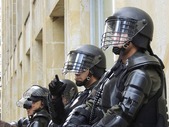
Secondly, there is the problem that if we adopt the principle of the greatest good for the greatest number then that means that the majority will always rule over the minority no matter the action. This is often illustrated through the hypothetical example of ten sadistic guards torturing one prisoner. Their torturing of the one cannot be prevented as ten sadists getting some pleasure outweighs the pain of the one.

Despite these criticisms Bentham’s principle of Utility would go on to spawn other versions of Utilitarianism that would attempt to deal with these problems. Thinkers such as J S Mill, Sidgwick, Hare, Glover and Singer have all created new versions of what might broadly be called Consequentialism. These theories together have influenced popular and political thought in ways that Bentham could have only dreamt.
If you want to know more about Utilitarianism I would suggest that you look at my recent post about In Our Time and their episode about it - you can find it here.

Dig Deeper: In Our Time

8/10/2015

 
Picture
Picture
Image: www.bbc.co.uk
In Our Time is a long running BBC radio 4 programme, presented by the polymath Melvin Bragg, that discusses the history of ideas. It has been running since 1998 and has a huge number of topics (610!) available to download for free.

There are normally three experts in their subject who are questioned and cross-examined by Bragg - he knows exactly how to extract ideas from them and is a master of questioning. His general knowledge must be phenomenal - a true renaissance man!

If you need any further endorsement it is Mr Hopcroft’s favourite radio programme and he allegedly has a poster of Melvin Bragg on his bedroom wall!
​
The main BBC website can be found here. You can then click on Podcasts and find radio programmes by categories such as Religion, Philosophy, History and Culture. They are also developing a very good Archive for searching as well.

A few episodes that you might find relevant to the GCSE/IGCSE and A-level courses are (Click on the image to listen to them):

Picture
The Ontological Arguement
Picture
Utilitarianism
Picture
The Mind Body Problem
Picture
Free Will
Picture
Logical Positivism
Picture
Heraclitus
Picture
Ockham's Razor
Picture
The Trinity
Picture
David Hume

Word of the Week: w/c 05/10/15 - Stewardship

4/10/2015


The belief that humans are responsible for the world and should look after it for God.

Picture
PictureImage: Stokpic
We only have to open a newspaper or turn on the TV to be confronted by that fact that humanity is facing a very large problem - how to deal with our environment and the effects that we have had upon the natural world. Climate Change is a phenomena that many scientists agree is being directly affected by human actions and in the past 40 years there has been a growing movement to ensure that humans act to reduce our impact upon the environment.


Christians have also been part of the green movement and there is a great deal in the Bible to support the idea that they have a special duty to care for the environment: As it says in Pslams: "The earth is the Lord's, and everything in it, the world, and all who live in it." (Psalm 24:1) or in Deuteronomy: "To the Lord your God belong the heavens, even the highest heavens, the earth and everything in it." (Deuteronomy 10:14). Many Christians feel that they should care for the world because it is not really theirs but rather belongs to God.

This can be seen in the second creation story in Genesis 2 when God creates the world and then creates Adam to “till and keep” the Garden of Eden; many liberal Christians interpret this Myth to mean that they have a responsibility to maintain the world and use its resources sustainably. They will have to give it back to God one day and certainly have to pass it on to the next generation.
PictureImage: ClkerFreeVectorImages
The wider debate is how we are to achieve this - are we to try and have the least impact upon the world by reducing, reusing and recycling straight away? Are we to turn to low-energy technology and renewable sources of energy such as wind, tide and solar? Do Governments have a duty to force us to adopt these practices? Should they be heavily subsidising the production of electric vehicles and taxing products with poor environmental credentials? Or would it be better in the long run to not try and interfere in the process of development and trust that necessity and market forces will bring about the changes needed. Indeed, there are many “Climate Change deniers” who argue that the state of the planet and man’s influence upon the climate has been over-stated.


Whatever the answer to these questions Christians still have many areas of their lives where they should consider Stewardship and the impact of everything belonging to God on their lives. Often Christians focus on Time, Treasures and Talents when considering how to act. This video from the Church of Scotland highlights the range of areas that Christians might consider in their lives:

<<Previous
Forward>>

    Archives

    June 2016
    May 2016
    April 2016
    March 2016
    February 2016
    January 2016
    December 2015
    November 2015
    October 2015
    September 2015
    July 2015
    June 2015
    May 2015
    April 2015
    March 2015
    February 2015
    January 2015
    December 2014
    November 2014
    October 2014
    September 2014
    August 2014
    July 2014

    Categories

    All
    Abortion
    Absolutism
    Agnostic
    Analogy
    Animal
    Apophatic
    A Priori
    Aquinas
    Article
    Assisted Dying
    Banking
    Bertrand Russell
    Book Review
    Buddhism
    Christianity
    Cosmological
    Covenant
    Dawkins
    Debate
    Design
    Diaspora
    Dig Deeper
    Dukkha
    Epiphany
    Equality
    Euthanasia
    Existentialism
    Fallacies
    False Dichotomy
    Family
    Fertility
    Genesis
    Hajj
    Higher Education
    Hindu
    Hinduism
    Holocaust
    Hospice
    Human Rights
    Human-rights
    Hume
    Islam
    ISRSA
    Judaism
    Justice
    JWT
    Lent
    Life After Death
    Love
    Martyr
    Messiah
    MOOC
    Narnia
    NDE
    News
    Nirvana
    Ontological
    Plato
    PPE
    Pro Choice
    Pro-Choice
    Pro Life
    Pro-Life
    Prophet
    Reformation
    Relativism
    Religion
    Rights
    Sabbath
    Science Vs Religion
    Secularisation
    Soul
    Sport
    Stewardship
    Surrogacy
    Teleological
    Temple
    Ten Commandments
    Theology
    Viability
    Via Negativa
    Vision
    Warfare
    Wittgenstein
    Word
    Word Of The Week
    Word-of-the-week

    RSS Feed

Powered by Create your own unique website with customizable templates.
Photos from sneakerdog, Steve Slater (Wildlife Encounters), Art4TheGlryOfGod, johndillon77, dustinj, Charlie Davidson, ineffable_pulchritude, LisaW123, jamee.khairul, Abode of Chaos, Dunleavy Family